We inhabit two worlds at once: one of concrete and another of pixels. And we often don't know who governs them. In our city there are cables running beneath our feet, data circulating as we walk, algorithms deciding what we see each morning.
This winter, at Canòdrom we invite you to become an archaeologist of the present. To lift the tiles to see what’s underneath, to dismantle screens to understand what’s behind them, to sew alternatives with open-source thread and needles of shared questions.
Over the coming months we’ll explore the city following the trail of the Internet, we’ll create video games that imagine fairer futures, we’ll learn to manage digital democracy, and we’ll rethink the tools that condition our daily lives. We’ll celebrate feminist resistance against constant mapping, we’ll discover the hidden territories of artificial intelligence, and we’ll experiment with networks that are truly ours. This isn’t just about looking. It’s about getting hands-on, undoing, redoing, repairing. Grab thread, needle and keyboard and let’s weave the future!
RRRepair the future cycle | February 19 – October
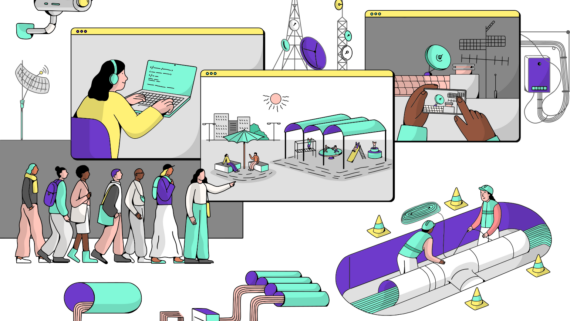
We live surrounded by underground cables, rooftop antennas, servers in industrial estates, and algorithms that decide what appears on our phones. All these networks condition how we inhabit the city, but we rarely see them. What if instead of always building more, we stopped to repair what we already have?
This cycle proposes looking at the city differently. We’ll start on February 19 with a conversation about what’s hidden beneath our feet, led by Gemma Barricarte, Radical Data and elii. On March 21 we’ll do the Internet Tour, a walk through the neighborhoods to discover where the cables, boxes and nondescript buildings that make the Internet work really are. And throughout spring and fall, we’ll continue with workshops, homemade prototypes and lots of free software to discover what lies beyond the screens.
More information and registration
Mapping generative AI | September 15 – March 27
Generative artificial intelligence is trendy, but do we really understand what’s behind it? This art installation by Taller Estampa invites you to pause and look beyond the technological mirage.
Where are the machines that make ChatGPT work? What resources do they consume? Who makes the decisions and who suffers the consequences? “Mapping Generative AI” focuses on everything that normally stays off the screen: the territories, infrastructures and material conditions that make it possible for us to generate texts or images in a matter of seconds. A critical and creative look at how AI intertwines with our lives and with other beings on the planet. The exhibition includes an audio guide that accompanies you through the journey and delves into the different layers of this invisible cartography.
Create your visual novel | Every wednesday from January 21 to March 25, 6 PM
Do you want to create narrative video games that question stereotypes and imagine fairer future societies? In this 10-session course you’ll learn to make visual novels with your own style: you’ll design bold characters, create dialogues, compose music and build a story that has real impact.
The Open University of Catalonia invites us to participate in doctoral research on how to educate through video games. During the sessions, we’ll explore how interactive narratives can generate awareness and transform those who play them. When you finish, you’ll have published your first visual novel. You don’t need to be a programmer or artist, just have the desire to tell stories that matter and make people rethink the world.
More information and registration
Book launch “Inteligencia Artificial: Jugar o romper la baraja” | January 29, 6 PM
What do we really know about artificial intelligence? How does it work? Who controls it? And what happens when we delegate important decisions to algorithms full of biases? Margarita Padilla presents her book accompanied by Carles Laparra to answer these questions and, above all, to propose taking action.
It’s not enough to demand better regulations. We need to get our hands dirty, dismantle the machine and reassemble it. Generate workshop dynamics, research, experiment and build alternatives from conflict and collective knowledge. Artificial intelligence raises questions about technology and about ourselves, forcing us to rethink who we are and what role we want it to play in our lives. AI is already part of our time. Do we play or break the deck?
March 8 at Canòdrom: The resisting body is the body that won’t be mapped | March 13, 4 PM
For the fifth consecutive year, we celebrate March 8 with a day dedicated to women and non-binary identities in the world of music and technology. This year, we ask: if we want to resist in the digital world, what must we learn?
We live in a paradox. While artists and creators struggle for visibility on platforms and in the music industry, artificial intelligence has already seen, learned from and cloned them all. Spotify knows us better than we know ourselves, facial recognition maps us on the street as if we were barcodes, and algorithms decide who deserves to be heard. But resisting isn’t disappearing: it’s learning how the game works to hack it. Music, hackathon, experimentation and pop resistance in a playful and festive day organized with DigitalFems!
More information and registration
Canòdrom’s Book Club
A space to pause, read calmly and think in community. Each quarter we’ll read a book related to digital culture and meet to discuss it together on a Wednesday afternoon, with coffee and pastries.
At the Canòdrom Book Club we read to imagine possible futures, better understand the present and build a more critical, creative and collective digital culture. We put words to doubts, discover new perspectives and share questions that don’t always have answers. A proposal to open pending conversations and think without hurry, in a relaxed atmosphere in the warmth of Canòdrom.
Check dates and readings at the Comunitat Canòdrom space
Learn Decidim for begginers | Fridays February 6, 13, 20 and 27, 12 PM
Decidim is the citizen participation platform used by everyone from the Barcelona City Council, Helsinki or Mexico City to initiatives like Som Energia, LaFede or FAVB. Want to learn how to use it?
At Canòdrom we offer a practical four-session training aimed at technical staff in charge of managing participation platforms. With an applied and problem-solving approach, we’ll explore participatory spaces, components, functionality and the potential of Decidim from a basic and introductory level. You’ll learn to create assemblies, participatory processes, collect proposals and manage them. With active participation you’ll obtain a certificate of completion. Democracy has never been so real!
More information and registration
Cycle: Training in ethical AI applied to the audiovisual sector | January – February
How do we use artificial intelligence in cultural projects? What does it imply ethically? And what open-source tools do we have available? This 6-session cycle combines critical thinking, situated conversations and practical learning around generative AI applied to different areas of digital creation.
We’ll open the cycle with Taller Estampa, who will provide a historical review of artificial intelligence from a critical thinking perspective, followed by a roundtable on AI and ethics to publish a collective manifesto. The following sessions will combine situated TED Talks on text, image, video, sound and post-production with conversations between humanist and technologist profiles, and practical training workshops to learn to use open-source tools. A space to experiment fearlessly and build alternatives around AI.
More information and registration
La Colla de les Dades | Biweekly thursdays, January 15 to March 12, 6 PM
What can we do with the city’s open data? How can we use it to better understand our environment and propose alternatives? La Colla de les Dades is a collaborative space where people from diverse backgrounds meet to share curiosity, ideas and desire to create data projects.
You don’t need to be a programming expert. There’s room here for those who bring an idea, for those who want to learn, for those with technical experience and for those who simply want to understand how open data works. We work with open-source tools and platforms, exploring open data repositories and creating projects that put technology at the service of the common good. Practical, flexible sessions open to everyone: come, propose, debate, share and experiment. The goal? Build alternatives to traditional data management models, promoting digital sovereignty and collective intelligence.
“Comfy n’chill” Free and local generative AI meetups | January 21 and March 18, 6 PM
ComfyUI is a programming environment for creating images with generative artificial intelligence locally, without depending on large platforms. If you want to learn to use generative AI with technological sovereignty, this working group is for you.
We’ll meet every two months to explore the tool in depth and make progress together. Each session will combine a brief introduction to better understand the project with time to organize into study groups according to interests and levels. We’ll get hands-on, experiment and share progress collectively. Bring your laptop (with GPU or Mac M4 minimum) and come experiment. If you don’t have a powerful computer, we’ll help you set up cloud programming environments.
More information and registration
Libremesh + Pirania Hackathon | January 23, 4 PM
How are community networks managed? How can we make them more accessible and secure? Pirania is a free software tool that allows managing who connects through vouchers, and works on Libremesh, a firmware for mesh networks.
In January there will be a hackathon in Brazil to develop a new version of Pirania. On January 23, the last day of the event, we’ll connect from Canòdrom to test the software on our experimental network. An opportunity to work remotely with the international community of free networks and see how collaborative development works live. Ideal for people with firmware development knowledge for routers (OpenWrt/Libremesh systems) or eager to learn by tinkering with code.
More information and registration
Digital tools for conscious organizations | January 30, 11 AM
WhatsApp, Google Drive, Mailchimp… The digital tools we use every day to coordinate and communicate have an impact. On our data, on our autonomy and also on the environment. But are there options that respect our planet and our privacy?
In this workshop we’ll pause to reflect on what tools we use in our organizations and what they imply. And we’ll explore together the ethical, sovereign and more sustainable options to digitize without giving up our autonomy or the planet. A space to rethink the digital transformation of organizations from technological sovereignty and environmental respect. Activity framed within the City Pact for Digital Rights and Democratic Technologies.
More information and registration
Course: We all must care for digital wellbeing! | March 10, 9:30 AM
5-hour course aimed at education professionals who want to delve into digital wellbeing. You’ll learn to foster active, creative and critical use of technology, identify risks and learn strategies to prevent them.
We’ll combine theory and practice with participatory dynamics, valuing shared knowledge among professionals. We’ll talk about how to promote critical understanding of digital wellbeing, foster creative use of technology, educate about risks, involve adults in responsible accompaniment and provide tools to manage digital time in a balanced way. A space to empower the professional collective and address DICT awareness and learning tasks in a critical and responsible manner.
More information and registration
Code Club Canòdrom | Every Tuesday, January 13 to March 31, 5:30 PM
Do you like robotics and programming? Want to take your projects a bit further? At Code Club Canòdrom you can create your own games, interactive stories and animations while learning to use technology creatively and critically.
Code Club Canòdrom is a free extracurricular programming and technology activity for youth ages 9-13 eager to create and experiment. Participants will work on digital and computational skills through creativity, collaboration and gender perspective. Through challenge-based activities, we’ll use Scratch to solve challenges of varying complexity. While shaping their projects, they’ll discover how technology works, develop critical thinking and learn to work as a team while having lots of fun.
More information and registration
Canodro’ms guided tour | February 27, 12 PM
Come discover Canòdrom: a building born as a greyhound racing track in the 1960s that today is a Digital and Democratic Innovation Hub. We’ll tour its spaces while explaining its history from greyhound races to conversations about artificial intelligence.
We’ll talk about open technologies, digital culture and democratic innovation, but also about how this building relates to the Bon Pastor neighborhood and the daily life that now flows through its rooms. A visit to understand what we do here and why, and how it has transformed into a meeting point to think about technology differently. Want to come with your collective on another date? Write to us at reserves@canodrom.barcelona.
More information and registration
Talk: Who’s who in the digital era? Dependency, sovereignty and progress | March 19, 6:30 PM
Cities are, historically, a space for struggle and defense of people’s rights. In the era of digital capitalism, the battle for digital rights also takes place in the municipal sphere. But who really controls the production and use of technologies that define contemporary capitalism?
Cecilia Rikap presents the book “Digital Dependency Theory” (Caja Negra) to answer this question. How do we read a world in which Google, Meta, Amazon and Microsoft control technological production and how this impacts digital peripheries like Latin America, Africa and Europe? If attempts to build digital sovereignty typically fail against the scale of these corporations, what roadmap can communities set to ensure digitization is fair, equitable and sustainable? This debate allows us to delve into the action lines of the Pact for digital rights and democratic technologies.
More information and registration
Open Classroom | Every Wednesday 12-2 PM and Thursday 4-6 PM
Canòdrom wants to continue being a place of public Internet access, facilitating its free use for all people who don’t have their own resources. Likewise, it wants to promote digital literacy in an increasingly digitized society, promoting a guidance and help service to bridge the digital and technological gap. Want to work at your own pace with your own computer? Looking for free, quality and secure WiFi connection? Resolve basic questions about your digital devices? This is your space.